
The /think Skill — Bloom's AI Framework v2 in Claude Code
Free, open-source skill that runs the v2 framework interactively in Claude Code. Quick mode for daily decisions, deep mode for serious work. Install in 2 minutes.

Jasem Neaimi
AI Collaboration Researcher
The /think skill brings Bloom's AI Collaboration Framework v2 directly into Claude Code. Type /think before any project, decision, or task — and Claude runs the protocol interactively, asking the questions only you can answer before writing a single line of code.
v2 of the skill ships with two modes, a 6+3 question set, a mechanically guaranteed L4↔L5 loop, and a 9-pillar taxonomy that adapts the questions to whatever pillar of life the decision touches.
What it does
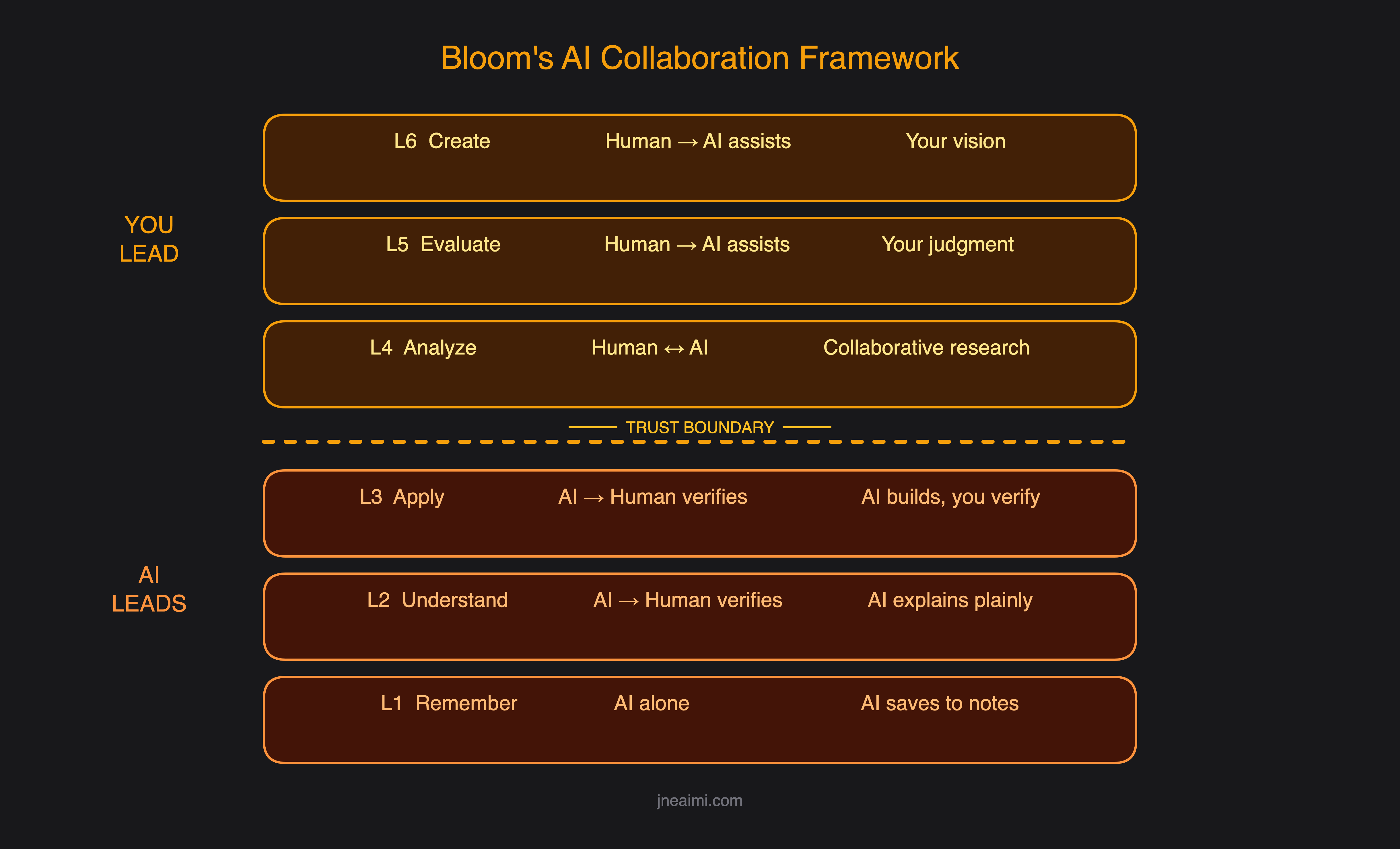
You lead the top. AI leads the bottom. Both collaborate in the middle.
When you type /think followed by a topic, Claude:
- Asks evaluative questions — adapted to the life pillar the topic touches (work, decisions, money, health, relationships, learning, identity, time/energy, faith). 3 questions in quick mode, 6+3 in deep mode.
- Researches based on your answers — web search, codebase analysis, whatever the task needs.
- Loops back — if research reveals something you haven't considered, it returns to you. v2 makes this loop mandatory in deep mode.
- Produces the deliverable — only after the decisions are made.
- Explains it — clause-by-clause, calibrated to your expertise.
- Saves it — to your notes with the sources, so the referent stays available for future audit.
Two modes
/think quick [topic] — three questions only (Purpose, Success, Scope). No research. Save is optional. For low-stakes daily decisions, personal-pillar work, fast exploration. Five minutes, no overhead.
/think [topic] — deep mode. Full 6+3 questions, mandatory L4↔L5 spiral, mandatory L3 deliverable, mandatory vault save. For serious work and high-commitment decisions — binding agreements, architectural bets, strategic pivots.
Default to deep mode whenever someone else will rely on the output, the output is hard to reverse, the domain requires expertise you don't have, or significant time/money is at stake.
Subcommands
/think continue— resume an interrupted session./think summary— show which levels are complete./think save— save the session output to your knowledge base./think pillars— pillar-balance tracker (which life pillars have been touched lately)./think feedback "..."— capture friction notes for future iterations.
The 6+3 universal questions
The questions belong to you. They adapt to the pillar — same skeleton, pillar-tuned wording.
Round 1 — Purpose, Resources, Success
- What is the purpose?
- What does each side bring?
- What does success look like?
Round 2 — Risk, Scope, Commitment (mandatory in deep mode)
- What am I afraid of?
- What's the scope?
- How deep am I going?
Round 3 — Epistemics (mandatory for heavy commitment)
- What am I assuming?
- Is this decision reversible?
- What would change my mind?
For a coding task, Q4 becomes "What breaks if you get this wrong?" For a money decision, "What can you afford to lose?" For a relationship decision, "What's the worst version of this conversation going wrong?" The skill wires the wording to the pillar automatically.
Real example
I used /think to draft a binding MOU for a UAE training partnership — with zero legal experience.
- Round 1+2: answered six questions about the partnership.
- L4: AI discovered MOUs are legally binding by default in the UAE — the opposite of most Western jurisdictions.
- L5 again: five new decisions surfaced from that single finding. The skill looped me back five times.
- L3: AI drafted a 14-clause document.
- L2: AI explained every clause in plain language.
- L1: AI saved everything to Second Brain with sources.
I walked out with a deliverable and enough understanding to take it to a UAE-qualified lawyer with informed questions. The framework was the accelerator — not a substitute for legal review.
Install
Two minutes. No dependencies. MIT-licensed. The skill ships with SKILL.md and pillars.md (the 9-pillar taxonomy) — both are required.
git clone https://github.com/jneaimi/blooms-ai-collaboration.git
cp -r blooms-ai-collaboration/skills/think ~/.claude/skills/think
Open a new Claude Code session and type:
/think [your topic]
Examples that work across pillars:
/think new SaaS product for HR teams(work)/think should I switch from REST to GraphQL(work)/think partnership agreement for training company(relationships, heavy commitment)/think career move from engineering to management(identity)/think quick how to respond to this email(decisions)
Why this matters
AI makes us faster. Faster at what? Skip evaluation and you're just building the wrong thing quicker.
The /think skill keeps the human in the driver's seat — asking the right questions before AI writes a single line. v2 hardens it: the questions are mandatory, the L4 loop is mandatory, and the framework announces itself when it auto-fires so the human can opt out.
AI should make us sharper thinkers, not lazier ones.
Related
- Bloom's AI Collaboration Framework v2 — the full theory behind this skill.
- Top-Down Learning with Bloom's Taxonomy — the cognitive science foundation.
- Evaluate Before You Build — the sister
/prebuildcheckpoint for code. - Print-grade v2 PDF — the canonical 14-section document.
- Repo on GitHub — framework, skill, pillar taxonomy, worked examples.
Get new insights
Subscribe for the latest research and frameworks, delivered to your inbox.