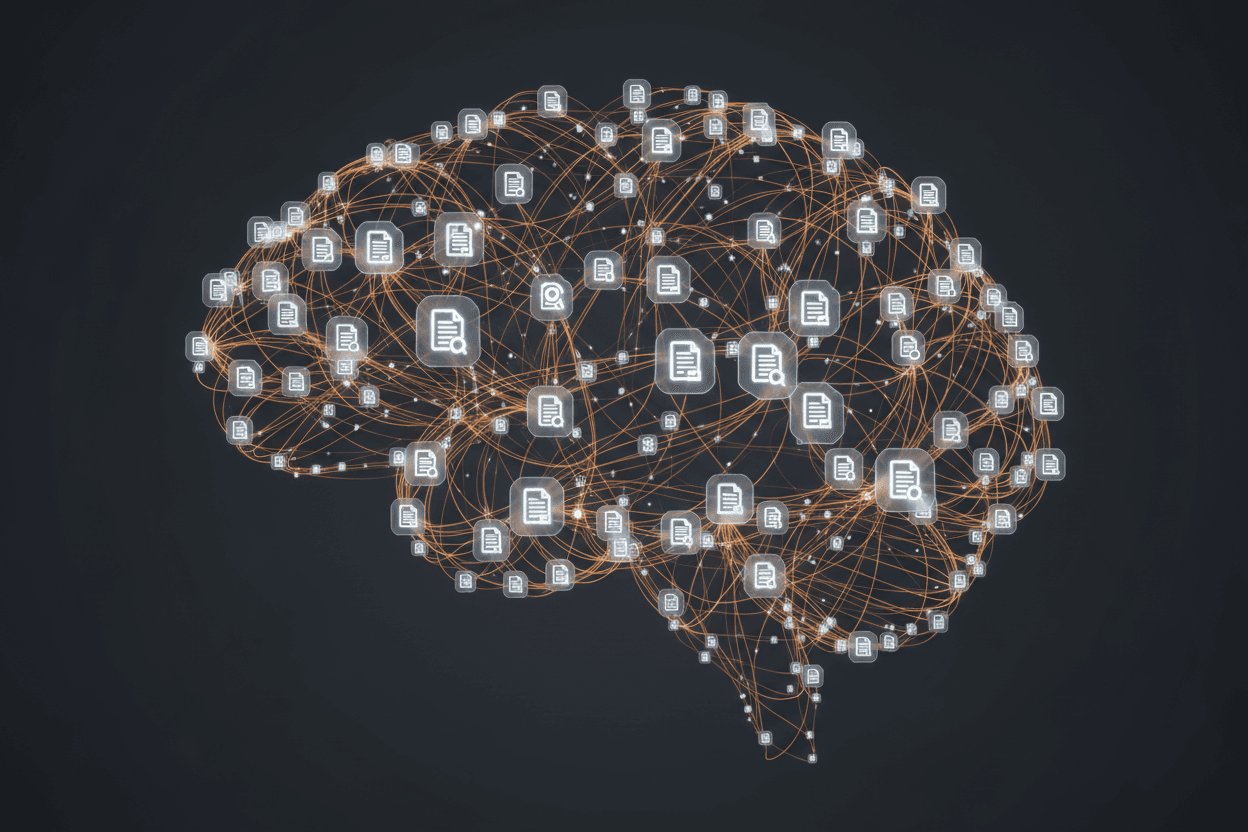
Building a Second Brain with Claude Code
How an Obsidian vault integrated with Claude Code creates persistent AI memory — solving the biggest pain point in AI development.

Jasem Neaimi
AI Collaboration Researcher
The #1 pain point in AI development tools is context loss. Every new conversation starts from zero. AI "forgets" your project, your preferences, and your past decisions. Developers build workarounds — memory plugins, planning files, context dumps — but none of them solve the fundamental problem.
The solution isn't bigger context windows. It's a persistent knowledge system that gives AI the right context at the right time.
The Setup
An Obsidian vault at a fixed path, synced across devices via iCloud, integrated directly with Claude Code through custom skills. No MCP servers, no complex infrastructure — just markdown files that Claude reads and writes.
Structure: Hybrid PARA + Developer
SecondBrain/
  00-inbox/       — Quick captures, unsorted notes
  01-projects/    — Active project tracking
  02-areas/       — Ongoing areas (coding, devops)
  03-resources/   — Patterns, snippets, debugging journals
  04-knowledge/   — Learnings, decisions, research
  05-archive/     — Completed items
  templates/      — Consistent note formats
The PARA method (Projects, Areas, Resources, Archive) gives structure. The developer-focused additions (debugging journals, ADRs, pattern libraries) make it useful for engineering work.
How It Works
The Principle: "Agents Read, Humans Write"
Claude extracts key insights from conversations and saves them as structured notes — not conversation dumps. Each note has frontmatter (type, date, tags), a clear title, and focused content.
When you start a new conversation, Claude reads relevant notes from the vault. Your past decisions, learned patterns, and project context are immediately available.
The Skills
Custom slash commands make interaction natural:
/brain save— After discovering something useful, save it to the right folder with proper formatting/brain search— Before starting new work, recall past learnings and patterns/brain review— Periodically organize and clean up the vault
Templates
Six templates ensure consistency:
- Project — Goals, status, decisions, links
- ADR (Architecture Decision Record) — Context, decision, consequences
- Debugging — Problem, investigation, solution, prevention
- Learning — Source, key insight, how to apply
- Pattern — Context, solution, trade-offs
- Snippet — Language, use case, code
Why This Matters
1. Persistent Memory Across Sessions
Every conversation with AI benefits from every previous conversation. Research findings inform coding decisions. Debugging solutions prevent repeated mistakes. Architecture decisions stay consistent.
2. Cross-Project Knowledge Transfer
Patterns discovered in one project are available in all projects. A debugging technique from a backend API informs a similar issue in a frontend app.
3. AI That Gets Smarter Over Time
The vault grows with every interaction. Claude's effectiveness in your specific context improves continuously — not through fine-tuning, but through accumulated structured knowledge.
4. Human-Readable, AI-Accessible
Everything is markdown. You can browse the vault in Obsidian with full graph visualization, backlinks, and search. Claude reads the same files directly. No format translation, no lock-in.
Connection to the Framework
The Second Brain is the infrastructure layer of the AI Collaboration Framework:
- Level 1 (Remember) — AI recalls past decisions and learnings from the vault
- Level 2 (Understand) — AI explains how current work relates to past patterns
- Level 3 (Apply) — AI uses saved snippets and templates for new work
- Level 4-6 — Human directs strategy, evaluates options, creates new approaches — informed by persistent knowledge
Without persistent memory, every AI session starts at zero. With it, you compound your thinking across every conversation.
The Real Win
The real win isn't productivity — it's cognitive continuity. Your AI collaboration doesn't reset. Your insights accumulate. Your thinking deepens over time rather than repeating.
This is what "thinking with AI" actually looks like in practice: not a better prompt, but a better system.
Get new insights
Subscribe for the latest research and frameworks, delivered to your inbox.