
The GCC Enterprise Agentic AI Decision Framework: Build, Buy, or Wait?
Most GCC enterprise leaders have AI pilots running but can't decide what's next. This three-axis framework — use case maturity, security posture, build capability — gives you a principled way to choose between building, buying, or waiting.

Jasem Neaimi
AI Collaboration Researcher
Most enterprise leaders right now are somewhere on the same spectrum: they have an AI pilot (sometimes several), they know agentic AI is the next frontier, and they cannot confidently decide what to do next.
Build a custom agent platform? Buy into NVIDIA NemoClaw? Wait for the market to consolidate?
The uncertainty is rational. And contrary to what most vendors will tell you, "wait and see" can sometimes be the right call — Forrester predicts enterprises will strategically delay 25% of their AI spending into 2027 as CFOs demand clearer ROI. But waiting without a framework is just drifting. This decision model gives you a principled way to decide.
Why This Decision Is Hard Right Now

Three things are true simultaneously, which makes the decision genuinely difficult:
1. The technology works. Agentic AI is not a demo. Enterprise deployments are running in production at Salesforce, Cisco, Adobe, and CrowdStrike — all NemoClaw launch partners. The GTC 2026 announcement was not a research preview. It was a go-to-market signal.
2. The trust problem is real. Amazon's AI deleted a production environment, causing a 6-hour outage. Replit's AI agent wiped a live database. DataTalks.Club lost 2.5 years of data to a Claude Code agent that executed a destructive operation it was given permission to run. The lesson isn't "don't use agents." It's "agent security is infrastructure, not configuration." And the threat surface is expanding: Non-Human Identities (NHIs) — bots, service accounts, and autonomous AI agents — now outnumber human identities in most enterprise environments, bypassing traditional DLP controls entirely.
3. The platform is still consolidating. We have four emerging platform stacks: NVIDIA (NemoClaw), Google (Vertex AI + managed MCP), Anthropic (Claude Dispatch), Microsoft (Azure Agent Framework). They're not interchangeable. Picking one today has architectural consequences.
The Framework: Three Evaluation Axes
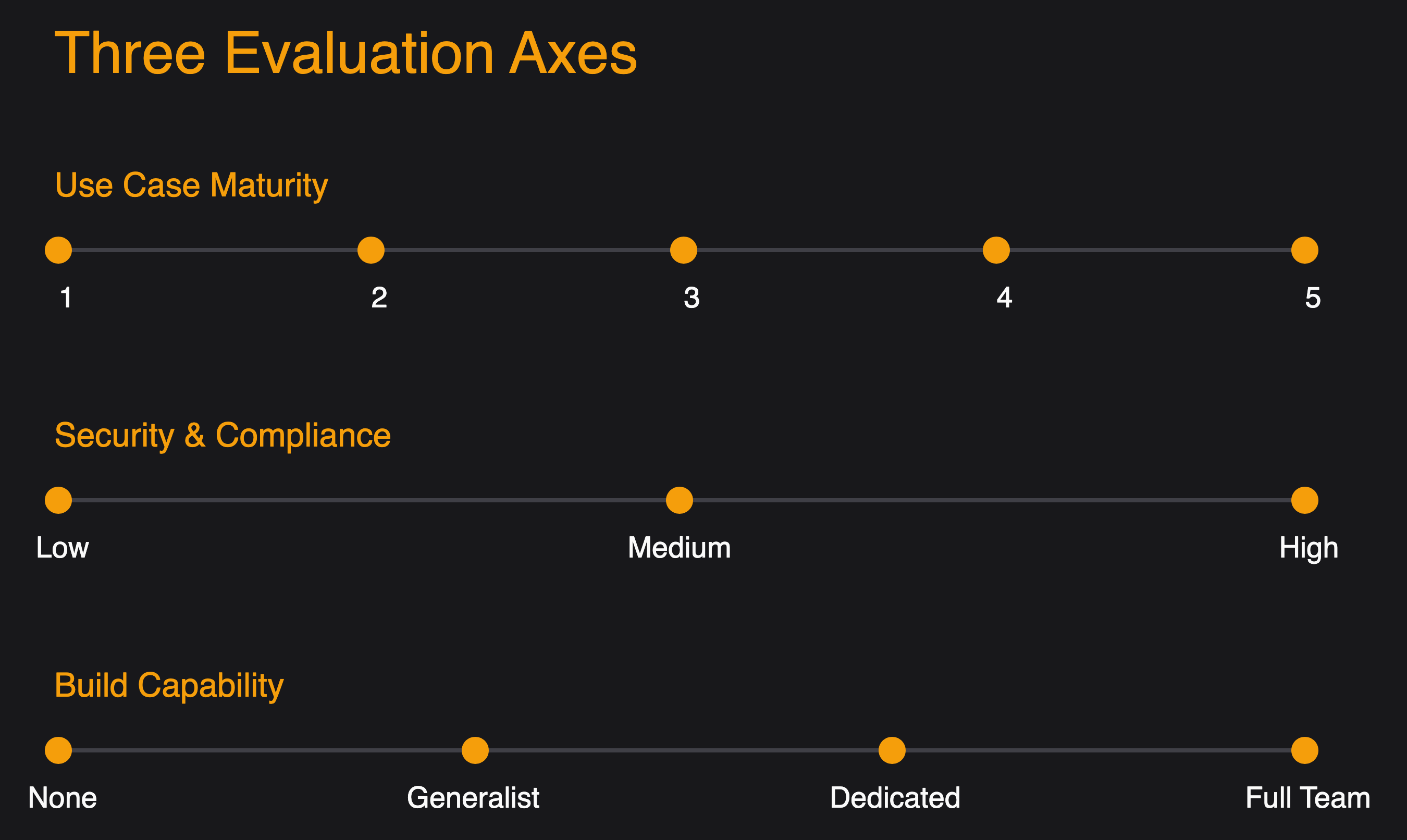
Evaluate your organization on three axes. Your position on each axis determines whether to Build, Buy, or Wait.
Axis 1: Use Case Maturity
How well-defined is the agent's task?
| Score | Description |
|---|---|
| 1 | "We want AI to help somewhere in our operations" |
| 2 | "We want agents in [department] but haven't scoped the task" |
| 3 | "We have a specific, repeatable workflow that costs 5+ FTE hours/week" |
| 4 | "We have a specific workflow, mapped decision trees, and known edge cases" |
| 5 | "We have a specific workflow, it's been audited, compliance has reviewed it" |
If you score 1-2: Wait. Not because the technology isn't ready — because you aren't ready. Agents without clear scope have higher failure rates and higher incident rates.
If you score 3-5: Proceed to Axis 2.
Axis 2: Security and Compliance Posture
How prepared is your organization for agent risk?
Agent risk is different from software risk. An agent with wrong permissions can take irreversible actions (delete records, send emails, execute transactions) at machine speed.
Key questions:
- Do you have an inventory of what systems an agent would need to access?
- Can you scope permissions to read-only for the MVP?
- Does your compliance team understand "agentic systems" as a risk category?
- Do you have audit logging for AI-driven actions?
- Do you have Zero Trust policies that extend to Non-Human Identities (NHIs) with continuous authorization?
If your answer to most of these is No: Your path is Buy + Managed Security (NemoClaw or equivalent enterprise-hardened stack). You need the guardrails as infrastructure before you customize. Note: only 50% of enterprise buyers place high trust in vendor reliability claims (Guidewise), so verify vendor security claims independently. G2 predicts that by end of 2026, more than half of enterprises will rely on specialized third-party AI governance services rather than vendor platforms alone.
If your answer to most of these is Yes: You have the option to Build — but be clear-eyed on cost. Analysis shows the total cost of ownership for a custom multi-agent system (including state management, observability, and evaluation) often exceeds a managed platform's cost by 3 to 5 times in the first year. A Hybrid approach — building on commercial foundation models with RAG and fine-tuning — delivers 90%+ of the customization value at only 10-20% of the cost of a full build.
Axis 3: Build Capability
Do you have the team to build and maintain agents?
Building agent systems in 2026 requires skills that are genuinely scarce: prompt engineering at the systems level, MCP integration experience, Skills architecture, and agent security. These are not skills you hire for from a generic "AI engineer" job description.
| Assessment | Implication |
|---|---|
| No dedicated AI engineering capability | Buy (commercial platform) |
| 1-2 AI engineers, generalist background | Buy + Customize |
| Dedicated AI platform team, agent experience | Hybrid (commercial foundation + RAG/fine-tuning) or Buy + Extend |
| Full ML/AI platform team, security expertise | Build (if differentiation justifies 3-5x TCO premium) |
GCC reality check: 94% of leaders report massive shortages in AI-critical skills — autonomous decision-making logic and multi-agent coordination talent is extremely scarce. 60% of GCC enterprises currently rely on consulting partners to get their first use cases into production. 66% of Gulf organizations operate a "Devolved" model where IT leads AI initiatives but Lines of Business sponsor and fund them. Factor this organizational reality into your build-vs-buy assessment.
The Decision Matrix
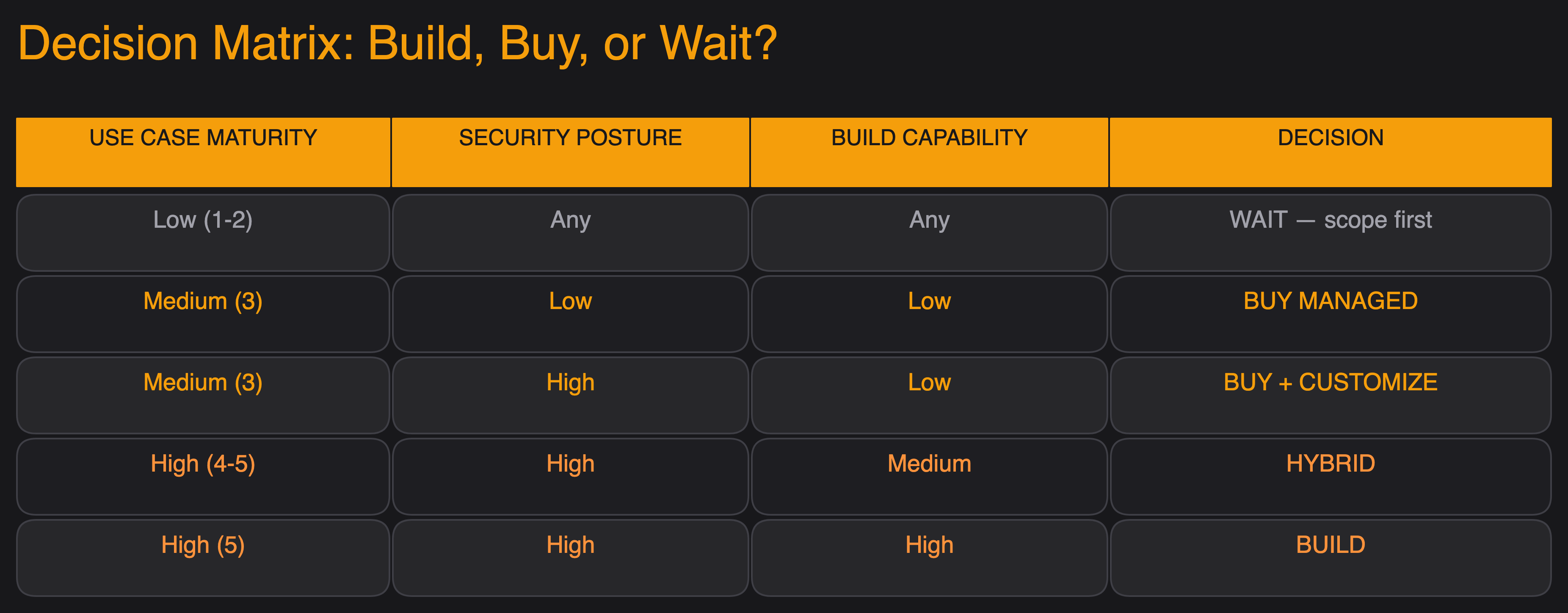
Important: The 2026 reality is not a single-vendor choice. Mature enterprises are adopting an "Agentic Mesh" — a modular, multi-framework approach. They use LangGraph for strict control on high-stakes infrastructure tasks, route business workflows to CrewAI (which deploys 40% faster for standard tasks), and use OpenAI for rapid, less complex sub-tasks. Your "Buy + Customize" path will likely involve blending multiple frameworks, not committing to a single stack.
The GCC-Specific Considerations

Data Residency and Sovereign AI
GCC enterprise deployments must navigate UAE PDPL (Personal Data Protection Law) and Saudi PDPL requirements. This makes on-premise or regional cloud deployments a requirement for many use cases, not a preference.
But data residency alone is no longer enough. The new standard is Sovereign AI — not just where data sits, but who holds administrative control. This is why enterprises are paying a premium for local sovereign clouds like Khazna and G42 to ensure compliance goes beyond geography to governance.
Leading GCC enterprises are adopting the "Data Airlock" model: using synthetic datasets and zero-trust infrastructure to allow global engineering teams to build on regulated systems while keeping encryption keys and administrative control under GCC jurisdiction. Evaluate whether your chosen platform supports this architecture before making an architectural commitment.
Also worth noting: Abu Dhabi's Falcon-H1R (a 7-billion-parameter hybrid model) is delivering reasoning capabilities matching systems seven times its size, making compact sovereign models viable for edge computing in energy and logistics — sectors where data cannot leave the premise at all.
Arabic Language Performance
Enterprise agents handling Arabic-language workflows (documents, communications, customer interactions) need to be evaluated specifically for Arabic NLP performance. Most agents built for English degrade significantly on Arabic — this is not a minor issue; it's a reliability problem. If your use case involves Arabic content, this should be a primary evaluation criterion, not a secondary one.
Mobile-First Operations
The GCC has among the world's highest smartphone penetration rates. The Anthropic phone agent signal (from the W12 signal report) points to mobile-first agent interaction as an emerging norm. GCC enterprises should evaluate agents not just for desktop/web use cases but for mobile orchestration — voice commands, WhatsApp integration, and phone-based workflow triggers are all in-market now.
Government and Sovereign AI
Several UAE and Saudi government entities are building sovereign AI platforms. If your organization interfaces with government systems, track the sovereign AI procurement timelines — they may create compatibility requirements that affect your platform choice.

Recommended Starting Point for Most GCC Enterprises
Based on where the majority of GCC organizations sit today (medium use case maturity, developing security posture, emerging AI team capability), the pragmatic path is:
Start with a bounded pilot on a managed platform (NemoClaw or Vertex AI managed MCP), with explicit security constraints from day one.
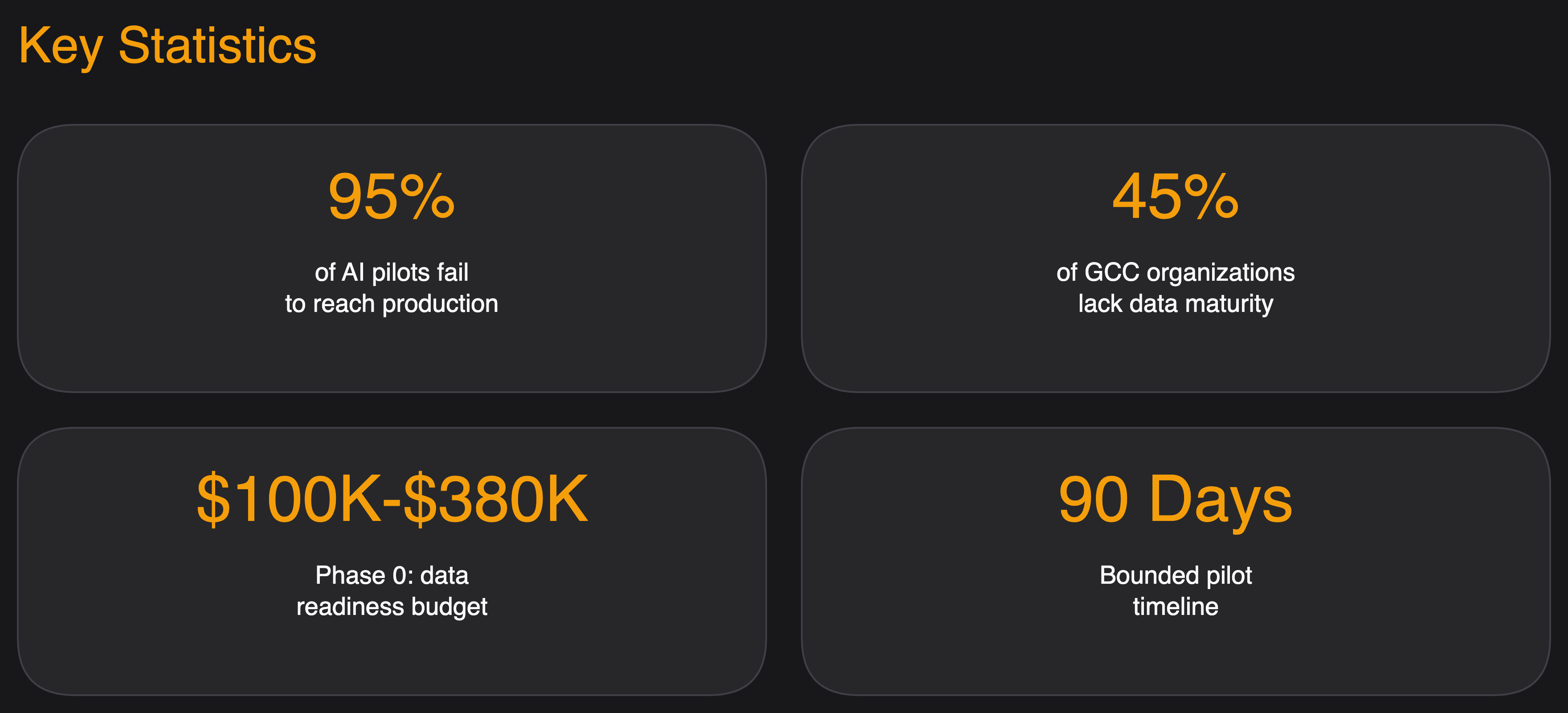
But first, a reality check: 95% of generative AI pilots fail to reach production, and the primary reason is inadequate data planning. 45% of GCC organizations report lacking the data maturity necessary to drive agentic projects. Digital leaders in the GCC are dedicating an average of 19% of their total IT budgets to agentic transformation — but skipping the data audit leads to 40-60% budget overspends.

Phase 0: Data Readiness (Before the Pilot) Before writing a single line of agent code, mandate a formal data readiness audit. Budget $100,000-$380,000 (20-30% of the AI budget) strictly for data cleansing and unifying legacy fragments. This is not optional overhead — it's the difference between the 95% that fail and the 5% that reach production.
Phase 1: Bounded Pilot (90 Days)
- Pick one workflow that scores 4+ on Use Case Maturity
- Deploy on a managed platform with read-only permissions for the MVP
- Implement Zero Trust for Non-Human Identities with continuous authorization — not just audit logging
- Run for 90 days with full monitoring
- After 90 days: evaluate whether to expand scope, add write permissions, or migrate to a hybrid/custom build
This is not the most technically ambitious path. It is the path most likely to produce a production system that survives contact with reality.
The Honest Outlook (Next 18 Months)
The platform consolidation will not complete before Q4 2026. The four major stacks will coexist, and some interoperability will emerge through MCP standardization. Here's what you need to know:
- Lock-in is manageable: Minimize lock-in at the data and workflow layer (even if you accept platform lock-in at the runtime layer). The Agentic Mesh approach lets you swap components without rebuilding everything.
- Early deployment compounds: You're building organizational capability and audit history, not just shipping features. But only if the deployment actually reaches production — which requires the data readiness and security foundations above.
- Waiting can be strategic, not passive: 56% of CEOs report getting "nothing" from their AI investments. Only 23% of enterprises are actually scaling AI agents (McKinsey). If your data isn't ready, your team isn't trained, or your use case scores below 3, a deliberate pause to build foundations is smarter than a premature pilot. The GCC organizations that will lead in 2027 are not simply the ones that started earliest — they're the ones that started correctly.
- Revenue expectations should be realistic: 62% of GCC organizations expect only 1-10% increase in top-line revenue from agentic AI (IDC/e& report). The near-term value is in operational efficiency and cost reduction, not transformative revenue growth. Frame your business case accordingly.
One Question to End With
When you think about AI agents in your organization, ask: "What is the most expensive workflow we run that has clear inputs, clear outputs, and a defined success metric?"
That's your starting point. Not the most exciting use case. Not the most transformative vision. The most expensive, clearest workflow.
Start there. Build the trust. Then expand.
Get new insights
Subscribe for the latest research and frameworks, delivered to your inbox.